

Poker games are among the most popular choices in both land‑based and online casinos. They stand out from pure chance games because they blend luck, psychology, and mathematics, allowing skilled players to gain an edge over time. Whether you’re playing low‑stakes home games, real‑money online tables, or casino poker games variants against the house, understanding the different poker games and how they work is essential.
This guide explains what poker is, standard hand rankings, the most common poker variants, how a typical Texas Hold’em hand plays out, key formats like cash games and tournaments, and practical strategy and responsible gambling tips for beginners.
What Is Poker Games?

Poker games is a family of card games in which players compete for pots—the total amount of chips or money wagered in a hand. Unlike many casino games, you don’t always need the best cards to win. You can also win pots by getting your opponents to fold better hands through betting and bluffing.
Most poker games share three core elements:
- Private cards: Each player receives some hidden cards (hole cards) that only they can see.
- Betting rounds: Players can check, bet, call, raise, or fold as the action goes around the table.
- Showdown or fold‑out: The pot is either won at showdown by the best five‑card hand, or by the last remaining player when everyone else folds.
Different variants change how many cards you get, whether there are shared community cards, and how betting is structured, but the underlying logic is similar.
Standard Poker Games Hand Rankings
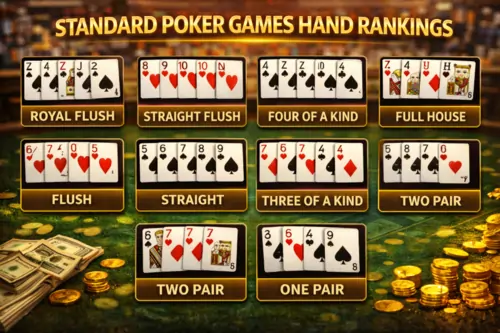
Every poker games player must know the standard five‑card hand rankings. From strongest to weakest:
- Royal Flush – A‑K‑Q‑J‑10, all of the same suit.
- Straight Flush – Five consecutive cards of the same suit (e.g., 9‑8‑7‑6‑5 of hearts).
- Four of a Kind – Four cards of the same rank (e.g., Q‑Q‑Q‑Q‑5).
- Full House – Three of a kind plus a pair (e.g., J‑J‑J‑8‑8).
- Flush – Five cards of the same suit, not in sequence.
- Straight – Five cards in sequence, mixed suits.
- Three of a Kind – Three cards of the same rank (e.g., 7‑7‑7‑K‑2).
- Two Pair – Two separate pairs (e.g., 10‑10 and 4‑4).
- One Pair – One pair plus three other cards.
- High Card – None of the above; your highest card decides.
These rankings apply to almost all poker games, including Texas Hold’em, Omaha, Stud, Draw, and many casino poker variants.
The Most Popular Poker Games
There are many poker games variants, but a few dominate both online and offline poker rooms. Focus on these first.
Texas Hold’em
Texas Hold’em is the most popular poker games in the world and the default format for major tournaments and many online cash games.
- Each player gets 2 hole cards (face‑down).
- Five community cards are dealt face‑up in the middle of the table.
- Everyone uses any combination of 2 hole cards + 5 board cards to form their best five‑card hand.
Betting rounds in Hold’em:
- Preflop – After each player is dealt two hole cards.
- Flop – After three community cards are dealt.
- Turn – After a fourth community card.
- River – After the fifth and final community card.
Hold’em is most commonly spread as No‑Limit Texas Hold’em (NLHE), where you can bet any amount of your stack at any time. There are also fixed‑limit and pot‑limit versions, but NLHE remains the flagship game.
Omaha
Omaha is a community‑card game very similar to Texas Hold’em, with one major twist:
- Each player gets 4 hole cards, not 2.
- You must use exactly 2 of your hole cards and 3 community cards to make your five‑card hand.
Because players see more cards, starting hands are stronger and draws are more common, leading to bigger pots and more action. The most popular version is Pot‑Limit Omaha (PLO), where you can bet up to the size of the pot.
Seven‑Card Stud
Before Texas Hold’em exploded in popularity, Seven‑Card Stud was the main poker games in many casinos.
- There are no community cards.
- Each player receives a mix of face‑up and face‑down cards over several betting rounds (streets).
- Players end up with seven cards and make the best five‑card hand.
Stud is usually played with fixed‑limit betting. Success in Stud relies heavily on memory and observation—keeping track of which ranks have already appeared face‑up and which cards folded players showed.
Five‑Card Draw
Five‑Card Draw is one of the simplest forms of poker and a common choice for casual home games.
- Each player receives five private cards.
- After an initial betting round, players may discard 1–3 cards (sometimes more or less, depending on house rules) and receive replacements from the deck.
- A final betting round occurs, followed by a showdown.
Because all cards are private and there are no community cards, Five‑Card Draw focuses on reading opponents and balancing your own drawing and pat (no‑draw) ranges.
Casino Poker Games Variants (Against the House)
Many casinos spread “poker” table games where you play against the house instead of other players:
- Casino Hold’em – A simplified Texas Hold’em‑style game versus the dealer.
- Three Card Poker – You get three cards and try to beat the dealer’s three‑card hand.
- Caribbean Stud Poker – Similar to five‑card stud, with fixed payouts and an optional progressive jackpot.
- Let It Ride and similar games – Use poker games hand rankings but pay out according to a paytable.
These games are easier for casual casino players but behave more like blackjack and baccarat because you’re facing the house, not trying to outplay other players.
How a Texas Hold’em Hand Works (Step‑by‑Step)
Because Texas Hold’em is the most important and common poker games, it’s worth walking through a full hand to see how betting and positions work.
Blinds and positions
Hold’em uses blinds to create initial action:
- Small blind (SB) – Player immediately to the left of the dealer button posts a smaller forced bet.
- Big blind (BB) – Next player posts a bigger forced bet.
Positions at a 9‑handed table (clockwise from the button) typically include:
- Button (BTN)
- Small blind (SB)
- Big blind (BB)
- Early positions (UTG, UTG+1…)
- Middle positions (MP)
- Late positions (cutoff, button)
Being on the button (acting last postflop) is the most powerful position.
Preflop
- Each player receives 2 hole cards.
- Starting with the player to the left of the big blind, action goes around the table. Each player can:
- Fold (give up).
- Call (match the big blind).
- Raise (increase the bet).
- Once action returns to the big blind and all bets are matched or folded, the preflop betting round ends.
Flop
- Three community cards are dealt face‑up (the flop).
- Starting with the first active player to the left of the button, another betting round takes place. Players can check (if no bet yet), bet, call, raise, or fold.
Turn
- A fourth community card (the turn) is dealt face‑up.
- Another betting round follows.
River
- A fifth community card (the river) is dealt face‑up.
- The final betting round takes place.
Showdown
If two or more players remain after the river betting round:
- They reveal their hands.
- Each player makes their best five‑card hand from any combination of 2 hole cards + 5 community cards.
- The best hand wins the pot. Ties split the pot.
Understanding this flow is critical because Omaha, some mixed games, and many casino poker Games variants are built around similar betting and positional structures.
If you want another illustrated walkthrough of a Texas Hold’em hand from shuffle to showdown, this William Hill poker rules guide covers blinds, betting streets and showdowns in detail.
Poker Games Formats: Cash Games vs Tournaments
Poker games can be packaged into different formats, each with its own feel and strategy.
Cash games
- You buy in with real money (chips have a fixed cash value).
- Blinds stay the same throughout the session.
- You can leave the game at any time, taking your chips (cash) with you.
Cash games are ideal if you want flexible session length and a steady structure. Mistakes can be expensive, but you can always top up (within table limits) or move down in stakes.
Tournaments
- You pay a fixed buy‑in and receive a set amount of tournament chips.
- Blinds increase over time following a predefined structure.
- When you lose all your chips, you’re usually eliminated (re‑entry options vary by event).
Tournament payouts go to players who survive deep into the event. You can invest a relatively small buy‑in for the chance at a big prize, but you can’t cash out early when ahead. Sit & Go’s are small, on‑demand tournaments; large multi‑table tournaments (MTTs) can involve hundreds or thousands of entrants.
Basic Poker Games Rules and Betting Actions
Most poker games use the same basic actions:
- Check – Pass the action without betting (only if no bet has been made yet in that round).
- Bet – Put chips into the pot when no one has bet yet in this round.
- Call – Match an existing bet.
- Raise – Increase the size of the current bet.
- Fold – Surrender your hand and any claim to the pot.
In no‑limit games, you can often bet any amount from the minimum up to your full stack. In limit and pot‑limit games, your bet sizing is constrained by fixed increments or the current size of the pot.
Core Strategy Tips for Poker Games Beginner
You don’t need to be an expert to significantly improve your results. These fundamentals will automatically put you ahead of many casual players.
1. Start with No‑Limit Texas Hold’em only
Instead of trying every variant at once, focus on NLHE first:
- It has the most resources (videos, books, articles, training tools).
- It runs at virtually every online poker games room and live card room.
- Concepts you learn in Hold’em carry over into other games later.
Once you’re comfortable, you can dip into Omaha, Stud, or niche casino poker games.
2. Play tight‑aggressive (TAG)
Beginner mistake number one is playing too many hands. A tight‑aggressive approach looks like this:
- Tight: Fold weak starting hands, especially out of position.
- Aggressive: Raise your good hands rather than limping or just calling.
As a beginner, avoid marginal hands like weak offsuit aces (A‑5 offsuit and worse), weak kings (K‑8 offsuit), and disconnected trash like J‑4, 9‑3, etc., especially from early positions.
3. Respect position
Position is one of the most powerful concepts in poker:
- Late positions (especially the button) act last on each street and see what others do first.
- This gives you more information, lets you control pot size better, and opens up more profitable bluffing opportunities.
As a simple rule:
- Play tight from early positions.
- Loosen up a bit in middle position.
- Play more hands on the cutoff and button where you’ll often be last to act.
4. Think in ranges, not single hands
Beginners often try to “put someone on a hand.” In reality, good players put opponents on a range—a set of possible hands based on:
- Their position.
- Their preflop raise or limp.
- How they react on each board card (check, bet, call, raise, fold).
You don’t need complex tools to start; just ask yourself, “Which types of hands would play this way?” rather than guessing a single exact holding.
5. Manage your bankroll
Poker games has a lot of variance; even if you play well, short‑term results can swing wildly. Bankroll management helps you survive bad runs.
- Keep a separate poker bankroll from your normal finances.
- For cash games, many players recommend at least 20–30 buy‑ins for your stake.
- For tournaments, variance is higher, so 50–100+ buy‑ins is safer.
Never move up to stakes where losing a few buy‑ins would affect your real‑life budget.
6. Avoid tilt and “chasing”
“Tilt” is when emotions (anger, frustration, ego) affect your decisions. To control it:
- Accept that bad beats and coolers are part of the game.
- Take breaks after big emotional hands.
- Avoid doubling or tripling your stakes to “get even” after losses.
Playing on tilt usually leads to more mistakes and bigger losses.
7. Study away from the table
You improve faster when you combine playing with deliberate study:
- Review hand histories, especially big pots you won or lost.
- Compare your decisions against basic strategy guidelines or training content.
- Focus on one area at a time (for example, preflop opening ranges, c‑betting, or river decisions).
Consistent, focused study adds up over time and sets you apart from purely recreational players.
Online Poker vs Live Poker Games
Each environment has its own rhythm and challenges.
Online poker
Advantages:
- Faster pace, more hands per hour (more learning opportunities).
- Wide range of stakes, including micro‑stakes and freerolls.
- Table selection and multi‑tabling options.
Challenges:
- No physical tells; you rely on timing and betting patterns.
- Easy access can tempt some players to overplay or chase losses.
- Different skill distributions; some online fields can be tougher than casual live games.
Live poker
Advantages:
- Social environment and live interaction.
- Physical tells and table talk can add information.
- More relaxed pace; some live games may be softer, especially at low stakes.
Challenges:
- Fewer hands per hour, so learning may feel slower.
- Requires travel and more time commitment.
- Live nerves for completely new players.
Many serious players blend both formats, using online for volume and practice and live games for social enjoyment and big events.
Responsible Gambling and Poker Games
Even though poker involves skill, it is still gambling and carries real financial and emotional risk. Keeping your play responsible protects both you and the people around you.
Best practices:
- Set limits: Decide in advance how much time and money you’re willing to spend on poker in a day or week. Stick to those limits.
- Separate money: Use only your poker bankroll for playing and never borrow money or use funds needed for essentials.
- Mind your state: Avoid playing when angry, stressed, drunk, or exhausted—these states lead to poor decisions and higher risk.
- Take breaks: Step away regularly, especially after big swings, to reset your thinking.
- Use tools: Many online platforms offer deposit limits, session reminders, time‑out periods, and self‑exclusion options. Use them if you feel control slipping.
If poker starts to negatively impact your finances, relationships, or mental health, reach out to local gambling support services or helplines. Getting help early is a positive, responsible step. Check this full responsible gambling policy content.
Major poker operators and media also maintain responsible gambling hubs, such as CardPlayer’s Responsible Gambling Guide and CoinPoker’s responsible gambling tools and tips, which explain how to use limits, time-outs and self-exclusion effectively.
Final Thoughts
Poker games remain a cornerstone of both live and online casinos because they reward learning, discipline, and good decision‑making rather than pure luck. By mastering basic hand rankings, focusing first on Texas Hold’em, learning how betting and position work, adopting a tight‑aggressive style, and managing your bankroll responsibly, you give yourself the best chance to enjoy poker games for the long term.
