
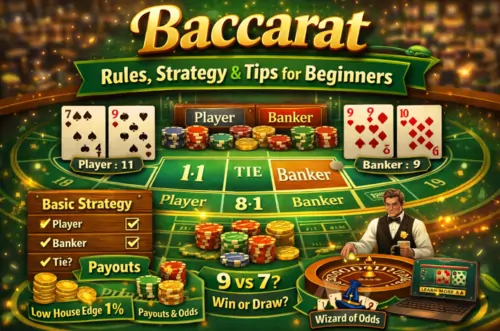
Baccarat is a classic casino card game known for its elegant image, simple decisions, and fast rounds. Once reserved for VIP rooms and high‑rollers, it is now widely available online and on regular casino floors, making it a great option for beginners who want a straightforward game with a relatively low house edge.
Despite its sophisticated reputation, baccarat is easy to learn. You don’t need advanced card skills or complex choices—most of the action is driven by fixed drawing rules. Your main job is to pick which side to bet on and how much to wager.
Basic Idea of Baccarat
Baccarat is played between two hands:
- The Player hand
- The Banker hand
You are not “the Player” hand; instead, you can bet on Player, Banker, or Tie. After the cards are dealt and any extra cards are drawn according to preset rules, the hand with a total closest to 9 wins. If both hands end on the same total, it’s a tie.
Card Values and Hand Totals
Baccarat uses a standard 52‑card deck (often multiple decks in a shoe), but card values are counted in a special way:
- 2–9: worth their face value
- 10, Jack, Queen, King: worth 0 points
- Ace: worth 1 point
Hand totals are calculated by adding card values and using only the last digit:
- 7 + 5 = 12 → total is 2
- 9 + 6 = 15 → total is 5
- 4 + 3 = 7 → total is 7
- 10 + 8 = 18 → total is 8
The best possible total is 9. A two‑card total of 8 or 9 is called a natural and often ends the round immediately.
How a Round of Baccarat Works (Step by Step)
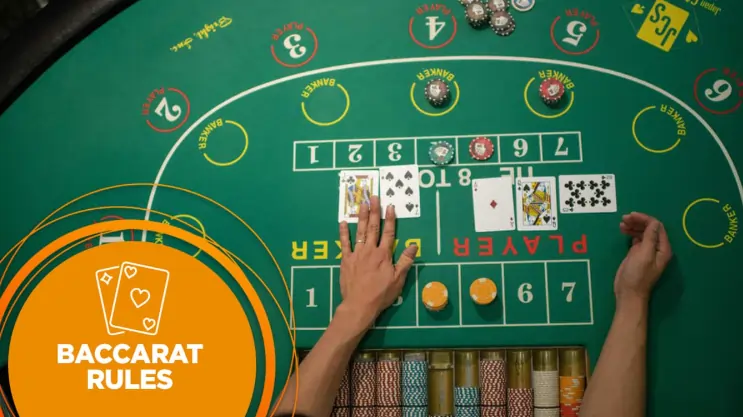
Baccarat follows a strict, predictable flow:
- Place Your Bet
Before any cards are dealt, choose one of the main betting options:- Banker
- Player
- Tie
Some tables also offer optional side bets such as Player Pair, Banker Pair, and others.
- Cards Are Dealt
The dealer deals two cards to the Player hand and two cards to the Banker hand from the shoe. - Check for Naturals
- If either hand has a total of 8 or 9 with the first two cards, this is a natural.
- If one hand has a higher natural, it wins immediately.
- If both have the same natural total, the result is a tie and Player/Banker bets usually push.
- Apply the Third‑Card Rules
If there is no natural, extra cards may be drawn based on fixed rules:- The Player hand typically draws a third card when its total is 0–5 and stands on 6–7.
- The Banker hand’s decision to draw or stand depends on both its current total and, in some cases, the Player’s third card.
- Determine the Winner
When all drawing is complete:- The hand closer to 9 wins.
- Bets on the winning side are paid.
- Bets on the losing side are collected.
- If both hands have the same total, Tie bets win, and bets on Player and Banker usually push (your stake is returned).
Main Types of Baccarat Bets
Most standard baccarat games are built around three core bets, with optional side bets for extra variety.
Banker Bet
- You bet that the Banker hand will finish closer to 9 than the Player hand.
- This is usually the strongest bet mathematically, with a house edge around 1.06%–1.24% in common multi‑deck games (after factoring in commission).
- Because Banker wins slightly more often than Player under standard rules, casinos typically charge a 5% commission on Banker wins (e.g., a 100 unit Banker win pays 95 net).
Player Bet
- You bet that the Player hand will finish closer to 9 than the Banker hand.
- This bet usually carries a house edge around 1.2%–1.3%, very close to the Banker bet but slightly higher.
- Player wins typically pay even money with no commission.
Tie Bet
- You bet that the Player and Banker hands will end with the same total.
- Tie often pays 8:1 or 9:1, which looks attractive, but the probability of a tie is low.
- This bet usually carries a much higher house edge of roughly 14%–15%, depending on the payout used at the table.
Because of this, Tie is best treated as an occasional side bet for fun, not a core strategy.
Common Side Bets
Depending on the casino or online platform, you may see:
- Player Pair / Banker Pair: betting that the first two cards of a hand form a pair.
- Perfect Pair, Big/Small, and other variants with different payouts and odds.
These side bets tend to have a higher house edge than the main Banker and Player bets, so they should be used sparingly if you care about long‑term efficiency.
House Edge in Baccarat (Simple Overview)
Exact numbers depend on rules and decks, but a typical multi‑deck game looks roughly like this:
- Banker bet: about 1.06%–1.24% house edge
- Player bet: about 1.2%–1.3% house edge
- Tie bet: around 14%–15% house edge (at 8:1 or 9:1 payouts)
That’s why serious players tend to:
- Prefer Banker as the mathematically best bet over time.
- Use Player as a solid alternative to avoid commission.
- Avoid relying on Tie due to its high house edge.
Basic Baccarat Strategy Tips for Beginners
Because baccarat uses fixed drawing rules and has limited decisions, “strategy” is mostly about which bet you choose and how you manage your bankroll, not about influencing how cards are drawn.
1. Prioritize Banker and Player
- Use Banker if you want the lowest house edge and don’t mind paying commission on wins.
- Use Player if you prefer straightforward even‑money payouts and slightly simpler accounting.
- Treat Tie as a rare, small side bet—never your main approach.
2. Manage Your Bankroll Smartly
Good bankroll habits matter even in low‑edge games:
- Set a total budget for your session and stick to it.
- Choose a base unit size (for example, 1–2% of your total bankroll) and bet consistently.
- Decide in advance on reasonable stop‑loss and win goals so emotions don’t drive your decisions.
3. Be Realistic About “Patterns”
Scoreboards and “roads” that track previous results (Banker/Player/Tie) are part of baccarat culture, but they don’t change the underlying probabilities.
- Streaks and patterns are interesting to watch and can add entertainment value.
- However, each new hand still follows the same rules and odds regardless of what happened before.
Use patterns for fun if you like, but don’t treat them as a system that can beat the game.
4. Avoid Aggressive Progression Systems
Systems that dramatically increase your bet after each loss or win (negative or positive progression) can create:
- Large bets during cold streaks
- Faster bankroll depletion
- A false sense of security
Flat betting or modest, controlled adjustments keep your risk more predictable and help you see the true variance of the game.
Common Beginner Mistakes in Baccarat
Beginners often make a handful of avoidable mistakes:
- Overusing the Tie Bet
Getting drawn in by the big payout and forgetting the very high house edge behind it. - Ignoring Banker Commission
Not accounting for the 5% commission on Banker wins when tracking results, leading to confusion about actual profit. - Chasing Streaks with Big Bets
Dramatically increasing bet size during perceived hot or cold streaks on Banker or Player, which can quickly burn through a bankroll. - Playing Without Clear Limits
Sitting down with no time limit, loss limit, or win target, making it easy to tilt and overspend. - Believing Baccarat is “Beatable” by Patterns Alone
Treating scoreboards as predictive rather than as a record of random outcomes governed by the same probabilities.
Baccarat: Luck vs Control
Baccarat is heavily luck‑driven compared to more decision‑dense games like blackjack. You have no say in how cards are drawn once you’ve placed your bet; the rules handle that for you.
However, you still have control over several key areas:
- You choose whether to bet on Banker, Player, or Tie.
- You set your bet size, session length, and budget.
- You decide how disciplined you are with limits and how often you indulge in high‑edge bets or side bets.
Viewed this way, baccarat is excellent for players who want a stylish, fast‑paced game with simple choices and strong odds on the main bets, without needing to memorize complex strategy charts.
Final Thoughts
Baccarat is a straightforward yet elegant table game that fits both cautious beginners and seasoned casino fans. With its simple rules, limited decisions, and relatively low house edge on Banker and Player bets, it offers a clean, efficient way to enjoy table games without a steep learning curve.
By understanding how hands are scored, how natural and third‑card rules work, why Banker and Player bets are mathematically sound, and how to manage your bankroll, you can approach baccarat confidently and responsibly—whether you’re playing in a live casino or online.
If you enjoy learning new casino titles, you can also explore our full range of casino games and classic table games.
