
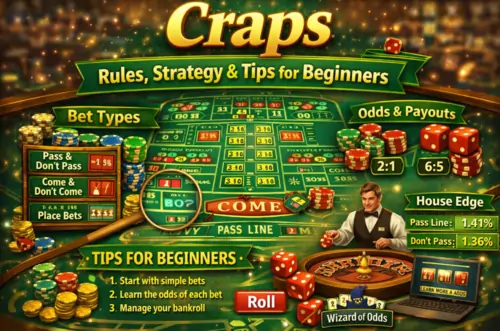
Craps is one of the most energetic and intimidating‑looking games in the casino, but underneath the noise and jargon, it’s a simple dice game built around a few core bets. Players wager on the outcome of rolls of two six‑sided dice, with the shooter (the player rolling) driving the action.
Although the craps table layout looks busy, you can play confidently by understanding the basic flow of the game, a handful of key bets, and how to manage your bankroll. You don’t need to learn every exotic wager to enjoy craps and keep the house edge low.
If you enjoy dice and table games, you can also explore our full range of casino games and classic table games.
Basic Idea of Craps
Craps is played with two standard six‑sided dice. The main action centers around the Pass Line and Don’t Pass bets during a sequence of rolls led by a shooter, just as you’ll see in step‑by‑step guides like Sycuan Casino’s beginner article.
- If you bet on the Pass Line, you are effectively betting with the shooter.
- If you bet on Don’t Pass, you are betting against the shooter.
The game alternates between two phases:
- The come‑out roll (the first roll of a new round).
- The point phase (after a point number is established).
Once you learn what happens on the come‑out roll and after a point is set, craps becomes much easier to follow.
How a Round of Craps Works (Step by Step)
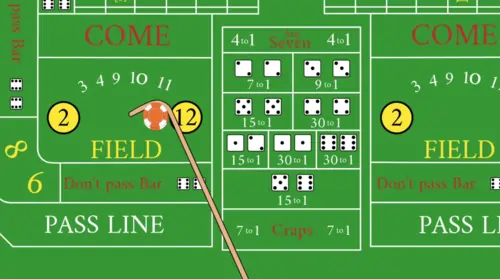
1. Come‑Out Roll
A new round starts when the shooter makes a come‑out roll.
- Before this roll, players can place Pass Line or Don’t Pass bets.
- The shooter then rolls both dice.
For Pass Line bets on the come‑out roll:
- Roll 7 or 11 → Instant win for Pass Line.
- Roll 2, 3, or 12 → Craps, Pass Line loses (12 often pushes on Don’t Pass depending on house rules).
- Roll 4, 5, 6, 8, 9, or 10 → That number becomes the point.
For Don’t Pass bets (the opposite side):
- Roll 2 or 3 → Don’t Pass wins.
- Roll 7 or 11 → Don’t Pass loses.
- Roll 12 → Usually a push on Don’t Pass (neither win nor loss), but check table rules.
- Roll 4, 5, 6, 8, 9, or 10 → That number becomes the point, and Don’t Pass bettors are now hoping for a 7 before the point repeats.
2. Point Phase
Once a point (4, 5, 6, 8, 9, or 10) is established:
- The dealer marks that number with a puck (“ON”).
- The shooter continues rolling until either:
- The point number is rolled again → Pass Line wins, Don’t Pass loses.
- A 7 is rolled (“seven out”) → Pass Line loses, Don’t Pass wins.
During this phase, players can also place additional bets (like Come, Don’t Come, odds bets, and various place bets), but the core game continues until the shooter hits the point or sevens out. After a seven out, a new shooter takes over and a fresh come‑out roll begins.
If you prefer to see this in diagram form, Island Resort & Casino’s guide at provides a helpful table layout and flow.
Key Craps Bets for Beginners
The craps layout includes many bets, but beginners only need a core group to play with good odds.
Pass Line
- Placed before the come‑out roll on the “Pass Line” area.
- Wins on 7 or 11 on the come‑out, loses on 2, 3, or 12, and otherwise travels with the point.
- Once a point is set, Pass Line wins if the point repeats before a 7, and loses if a 7 comes first.
- This is one of the best, lowest‑house‑edge bets on the table.
Don’t Pass
- The opposite of Pass Line; placed on the “Don’t Pass” bar before the come‑out roll.
- Wins on 2 or 3, loses on 7 or 11, and often pushes on 12.
- After a point is set, Don’t Pass wins if a 7 is rolled before the point, and loses if the point repeats first.
- Also a low‑edge bet, though often less popular socially because you’re betting against the shooter.
Come and Don’t Come
These are similar to Pass Line and Don’t Pass, but placed after a point is already established:
- Come:
- Bet is placed in the “Come” box after a point has been set.
- The next roll acts like a mini come‑out roll for this bet:
- 7 or 11 → Come wins.
- 2, 3, or 12 → Come loses.
- 4, 5, 6, 8, 9, or 10 → That number becomes the “Come point”. Come wins if that number appears before a 7, and loses on a 7 first.
- Don’t Come:
- Works like Don’t Pass but after a point is established, with similar reverse outcomes.
Odds Bets (Taking and Laying Odds)
Once a point (or a Come/Don’t Come point) is set, you can make odds bets behind your original wager:
- Taking odds (behind Pass Line or Come):
- You bet extra money that the point will be hit before a 7.
- Pays at true odds (no house edge), such as:
- 4 or 10: 2:1
- 5 or 9: 3:2
- 6 or 8: 6:5
- Laying odds (behind Don’t Pass or Don’t Come):
- You bet that a 7 will be rolled before the point.
- Also pays true odds, but you risk more to win less (the reverse of taking odds).
Odds bets have zero house edge, but they are only available in combination with Pass/Don’t Pass or Come/Don’t Come bets, which still carry a small edge for the casino.
Place Bets (On Numbers)
During the point phase, you can “place” bets directly on numbers 4, 5, 6, 8, 9, or 10:
- You are betting that your chosen number will be rolled before a 7.
- Payouts vary by number (for example, 6 and 8 usually pay 7:6, 5 and 9 pay 7:5, 4 and 10 pay 9:5).
- Place bets have a slightly higher house edge than Pass/Don’t Pass with odds, but can still be reasonable if you choose the best numbers (often 6 and 8).
Proposition and One‑Roll Bets
In the center of the table, you’ll see a cluster of “prop” bets:
- Hardways, any 7, any craps, specific doubles, and more.
- Many of these are one‑roll bets with higher payouts and much worse odds.
- They can be fun for small, occasional wagers, but they are not recommended as your main strategy because they carry high house edges.
House Edge: Why Bet Selection Matters
The craps table is one of the few places in the casino where you can choose between very low‑edge bets and very high‑edge bets all on the same layout.
Typical house edge ranges (approximate):
- Pass Line / Come: low house edge (around 1–2% in many rule sets).
- Don’t Pass / Don’t Come: similarly low, sometimes slightly better than Pass/Come.
- Odds bets: 0% house edge (true odds), but only combined with qualifying bets.
- Place bets on 6 or 8: reasonable, but higher edge than Pass/Come with odds.
- Proposition and one‑roll bets: often very high house edge, some of the worst in the casino.
Focusing on the low‑edge core bets and odds, and avoiding or minimizing proposition bets, is one of the simplest ways to play craps smarter.
Basic Craps Strategy Tips for Beginners
Craps doesn’t have a complex playing strategy like blackjack, but you can still make smarter decisions by choosing the right bets and managing your bankroll.
1. Keep It Simple at First
Start with a basic, low‑edge approach:
- Bet Pass Line (or Don’t Pass if you’re comfortable betting against the shooter).
- When a point is established, take odds behind your Pass Line bet.
- Avoid side bets and the busy center of the table until you’re more experienced.
This keeps the game easy to follow and uses some of the best odds available.
2. Use Odds Bets When You Can
If your bankroll allows it, adding odds behind your Pass/Don’t Pass or Come/Don’t Come bets:
- Reduces the overall house edge on your total action.
- Gives you the fairest return on additional money at risk.
Just remember that while odds bets have no house edge, they still carry risk—losing streaks can happen even with fair odds.
3. Be Careful with Proposition Bets
The attractive payouts in the center of the table can be tempting, but:
- These bets tend to have much higher house edges.
- Regularly betting on them can erode your bankroll quickly.
If you want to try them, treat them as small, occasional “fun” bets, never your main strategy.
4. Manage Your Bankroll
Because craps can feel fast and exciting, it’s easy to overspend without noticing.
- Set a firm budget before you start.
- Choose a base bet size that lets you enjoy many rolls without risking too much per round.
- Decide in advance when you’ll leave the table or take a break, whether you’re winning or losing.
Common Beginner Mistakes in Craps
New craps players often make mistakes that are easy to avoid once you know what to look for:
- Trying too many bets at once
Spreading chips all over the layout before understanding what each bet does. - Ignoring the difference between low‑edge and high‑edge bets
Treating Pass Line with odds and high‑edge prop bets as equally good options. - Chasing losses with bigger and riskier bets
Increasing bet size dramatically during cold streaks and moving into the center of the table to “get even”. - Not asking for help
Feeling intimidated by the layout and table etiquette, instead of asking the dealer simple questions; dealers are used to guiding beginners. - Playing without limits
Sitting down without a budget, time limit, or win/loss goals, which makes emotional decisions more likely.
Craps: Luck vs “Strategy”
Craps is heavily luck‑based, because each dice roll is random and independent, and you don’t influence how the dice land. However, you still have meaningful control over:
- Which bets you choose (low‑edge vs high‑edge).
- How much you wager each round.
- How long you play and when you walk away.
Smart craps play is less about predicting specific numbers and more about selecting the bets that keep the house edge low, using odds, and managing your bankroll responsibly.
Final Thoughts
Craps is one of the most exciting games in the casino, but it doesn’t have to be confusing. By learning the basic flow (come‑out roll, point phase), focusing on a handful of core bets (Pass/Don’t Pass, Come/Don’t Come, odds), and avoiding high‑edge proposition bets, you can enjoy fast‑paced action without getting lost in the layout.
Once you’re comfortable with the fundamentals, you can explore more advanced bets and styles of play at your own pace—while keeping the core principle in mind: choose bets with better odds, manage your bankroll, and treat craps as entertainment, not a guaranteed way to profit.
