
If you enjoy Texas Hold’em but want more action, deeper strategy, and bigger average pots, Omaha poker is the perfect next step. This guide will walk you through the rules, hand rankings, basic strategy, and key mistakes to avoid so you can confidently sit at any online Omaha table—whether you’re playing for fun or preparing for real‑money games. For an additional overview, you can also check a reputable rules guide like PokerNews’ Omaha section.
What Is Omaha Poker?
Omaha poker is a community card game similar to Texas Hold’em, but with one key difference: each player is dealt four hole cards instead of two. To make a hand, you must use exactly two of your four hole cards and exactly three of the five community cards on the board.
This simple rule creates far more possible combinations than Hold’em, which leads to stronger average hands, more action, and a more strategic style of play.
How to Play Omaha Poker (Step‑by‑Step)
- Blinds and dealing
- The hand begins with small and big blinds, just like Texas Hold’em.
- Each player is then dealt 4 face‑down hole cards.
- The community cards
- Flop: 3 community cards are dealt face up.
- Turn: 1 additional community card is dealt.
- River: 1 final community card is dealt.
- In total, there are 5 community cards on the board.
- Building your hand
- You must use exactly 2 of your 4 hole cards.
- You must use exactly 3 of the 5 community cards.
- The best 5‑card poker hand at showdown wins the pot.
The Crucial “Two‑Card Rule” (Most Common Beginner Mistake)
You cannot:
- Use only 1 hole card.
- Use 3 or 4 hole cards.
- “Play the board” with 0 hole cards.
Example:
If the board shows a flush (say four hearts on the table), you still need two hearts in your hand to make a flush. One heart in your hand is not enough in Omaha, even if there are four hearts on the board.
This rule is where many new Omaha players lose money, so it’s vital to master it early.
Poker Hand Rankings
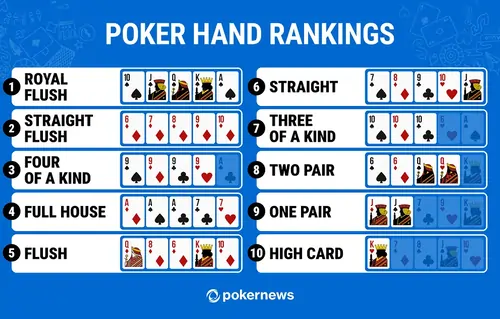
Omaha uses the standard poker hand rankings:
- Royal Flush
- Straight Flush
- Four of a Kind
- Full House
- Flush
- Straight
- Three of a Kind
- Two Pair
- One Pair
- High Card
Because everyone has four hole cards, stronger hands appear much more often than in Texas Hold’em. In many Omaha pots, one pair or a weak two pair will rarely be good by the river.
Main Types of Omaha Poker
1. Pot‑Limit Omaha (PLO)
- Most popular Omaha format online and live.
- You can bet up to the size of the pot at any time.
- Creates large pots, frequent big draws, and aggressive action.
- Best starting point for most Omaha players.
2. Hi‑Lo (Omaha 8 or Better)
- The pot is split into:
- Best high hand.
- Best qualifying low hand (5 cards, all 8 or below, no pairs).
- Requires you to think about winning both halves of the pot.
- More complex and better suited for players who already understand basic Omaha.
3. Fixed‑Limit Omaha
- Betting amounts are fixed (for example, 2/4 or 5/10).
- Pots grow more slowly and swings are smaller.
- Good for beginners who want to learn the rules without facing huge bets.
Best Starting Hands in Poker
Choosing strong starting hands is critical because marginal hands get punished in Omaha’s big, multi‑way pots.
Strong Hands to Play (Premium and Semi‑Premium)
- Double‑suited A‑A‑K‑K
- A‑K‑Q‑J (especially double‑suited or well‑connected)
- Double‑suited high connectors (e.g., 10‑J‑Q‑K)
- Hands that:
- Are connected (can make strong straights).
- Have flush potential (double‑suited is ideal).
- Include high cards that can make nut hands.
Hands to Avoid or Play Carefully
- Unconnected “junk” like 2‑7‑9‑K.
- Single‑suited weak hands with low cards.
- Four low, uncoordinated cards (e.g., 3‑5‑7‑9 rainbow).
The key idea: you want hands that can make multiple strong combinations, not just one small pair or a weak draw.
Omaha Poker Strategy: How to Win More Often
1. Play Tight and Selective Pre‑Flop
- Do not play every hand just because you have four cards.
- Fold weak, uncoordinated hands.
- Focus on starting hands that can realistically make the nuts (best possible hand) or very strong draws.
2. Think in Combinations, Not Single Cards
In Omaha, you should evaluate:
- Straight potential (multiple connected cards).
- Flush potential (double‑suited hands are gold).
- Full house possibilities (paired boards combined with your hand).
Always ask: How many strong ways can this hand connect with different boards?
3. Respect the Power of Draws
- In Omaha, big combo draws (e.g., straight + flush draw + overpair) often have huge equity.
- A strong draw can sometimes be better than a weak made hand like top pair or bottom two pair.
- Avoid stacking off with fragile made hands when many stronger hands or big draws are possible.
4. Watch the Board Texture Closely
Always consider:
- Are there obvious straight or flush possibilities?
- Could someone have a higher straight or flush than you?
- Has the board paired, making full houses possible?
If the board is very “wet” (many draws possible), be careful overvaluing medium‑strength hands.
5. Manage Your Bankroll
Omaha is more volatile than Hold’em because:
- Pots get big fast in PLO.
- Players often have strong draws and big made hands clashing.
Set clear limits:
- Decide your session budget before playing.
- Stick to low‑stakes games while you’re still learning.
- Never chase losses—walk away when you hit your limit.
Common Beginner Mistakes in Poker
Avoid these expensive errors:
- Playing too many weak, uncoordinated hands.
- Forgetting the two‑card rule and misreading your hand.
- Overvaluing top pair or a small two pair.
- Ignoring the board texture and opponent ranges.
- Chasing low‑equity draws when the pot odds don’t justify it.
Omaha Poker vs. Texas Hold’em
| Feature | Omaha Poker | Texas Hold’em |
|---|---|---|
| Hole cards | 4 cards | 2 cards |
| Cards you must use | Exactly 2 hole + 3 board | Any combination of 0–2 hole cards |
| Average hand strength | Higher (stronger hands common) | Lower (one pair often wins) |
| Strategy depth | High, more complex | Moderate, more straightforward |
| Variance | Higher, bigger swings | Lower, more stable |
Omaha is ideal for players who enjoy deep strategy, big draws, and high‑action pots, while Hold’em is a bit simpler and more beginner‑friendly.
Why Omaha Poker Is So Popular Online
Players love Omaha because it offers:
- Bigger pots and more frequent all‑in situations.
- More possible hand combinations and creative lines.
- Strategic depth that keeps experienced players engaged.
For many, it’s the natural next step after mastering Texas Hold’em.
Responsible Gambling Reminder
Poker is a mix of skill, math, and luck. To keep it fun and safe:
- Set a clear budget before you play.
- Avoid chasing losses or tilting after bad beats.
- Take regular breaks and treat the game as entertainment, not a way to “earn back” money.
Responsible play helps you enjoy Omaha longer and make better decisions at the tables.
