
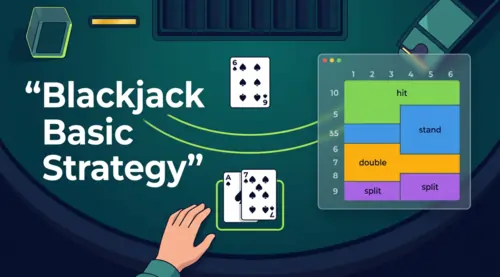
Blackjack is one of the few casino games where your decisions really matter. Blackjack basic strategy is the proven way to play every hand so you lose less over time and give yourself the best possible chance to walk away ahead.
In this guide, you’ll get a clear, beginner‑friendly breakdown of blackjack rules, basic strategy for every type of hand, and quick shortcuts you can use right away at any online or live casino table.
How Blackjack Works (Fast Refresher)
The goal in blackjack is beating the dealer without going over 21.
- Number cards (2–10): worth their face value.
- J, Q, K: each worth 10.
- Ace: can count as 1 or 11, whichever helps your hand.
Round flow:
- You place your bet and receive two cards.
- The dealer gets two cards (one face up, one face down).
- You decide how to play your hand.
- The dealer then draws according to fixed house rules.
Basic actions:
- Hit – take another card.
- Stand – keep your total and end your turn.
- Double down – double your bet, take one card only, then stand.
- Split – if your first two cards are a pair, you can split them into two hands for an extra bet.
- Surrender (if available) – give up the hand and lose half your bet.
Common house rules (what this strategy assumes):
- Multi‑deck game (4–8 decks).
- Dealer hits on soft 17 (H17).
- Doubling allowed on any two starting cards.
- Doubling after split allowed.
If your table uses different rules (like dealer stands on soft 17, or no doubling after split), the core ideas still hold, but some edge cases change slightly.
What Is Blackjack Basic Strategy?

Basic strategy is a chart of optimal decisions telling you exactly when to hit, stand, double, or split based on:
- Your hand (total and composition).
- The dealer’s face‑up card.
It’s built from math and millions of simulated hands, not “hunches.” When you follow basic strategy correctly:
- You cut the house edge to around 0.5% or better in good games.
- You avoid the most expensive mistakes beginners make, like standing too early or splitting the wrong pairs.
You won’t win every hand, but over the long run, you will play as efficiently as possible without needing card counting or advanced techniques.
For full multi‑deck basic strategy charts and rule‑specific variations, you can also check the detailed blackjack strategy charts at Blackjack Apprenticeship.
Hard Hands: No Ace (or Ace Counted as 1)
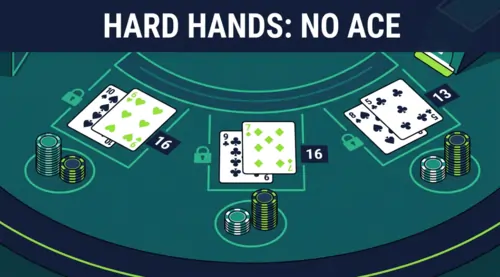
A “hard” hand has no Ace counted as 11, like 10‑6 (hard 16) or 9‑7‑2 (hard 18). If you bust, you’re done, so these hands are more rigid.
Hard totals basic strategy
Use these rules as your default:
- Hard 8 or less
- Always hit.
- Hard 9
- Double vs dealer 3–6.
- Otherwise hit.
- Hard 10
- Double vs dealer 2–9.
- Hit vs 10 or Ace.
- Hard 11
- Double vs dealer 2–10.
- Hit vs dealer Ace (unless your game is very favorable and you prefer doubling).
- Hard 12
- Stand vs dealer 4–6.
- Otherwise hit (vs 2, 3, 7–Ace).
- Hard 13–16
- Stand vs dealer 2–6.
- Hit vs dealer 7–Ace.
- Hard 17 or more
- Always stand.
Key idea: when the dealer shows a weak card (2–6), you can afford to stand more often and let the dealer make mistakes. When the dealer shows a strong card (7–Ace), you must be more aggressive and hit, even if it feels uncomfortable.
Soft Hands: Flexible Aces
A “soft” hand contains an Ace counted as 11, like A‑6 (soft 17). If you draw a big card, you can “drop” the Ace to 1 and avoid busting, which makes these hands great for doubling.
Soft totals basic strategy
- Soft 13 (A‑2) and soft 14 (A‑3)
- Double vs dealer 5–6.
- Otherwise hit.
- Soft 15 (A‑4) and soft 16 (A‑5)
- Double vs dealer 4–6.
- Otherwise hit.
- Soft 17 (A‑6)
- Double vs dealer 3–6.
- Otherwise hit.
- Soft 18 (A‑7)
- Stand vs dealer 2, 7, 8.
- Double vs dealer 3–6.
- Hit vs dealer 9, 10, Ace.
- Soft 19+ (A‑8, A‑9)
- Always stand (except for rare advanced plays).
Key idea: use soft hands to attack weak dealer cards by doubling. You have safety because the Ace can drop from 11 to 1 if you draw high.
Pair Splitting Strategy
Pairs give you the option to split and play two hands. Done correctly, this reduces losses on bad starting totals and maximizes profit on strong ones.
Core pair‑splitting rules
- Always split Aces.
- Always split 8s.
- Never split 5s (treat as hard 10 and use the hard‑hand rules).
- Never split 10s (including J‑Q, Q‑K, etc.) – 20 is already a powerhouse.
For the other pairs:
- 9‑9
- Split vs dealer 2–6 and 8–9.
- Stand vs dealer 7, 10, Ace.
- 7‑7
- Split vs dealer 2–7.
- Otherwise hit.
- 6‑6
- Split vs dealer 2–6.
- Otherwise hit.
- 4‑4
- Split vs dealer 5–6 (if doubling after split is allowed).
- Otherwise hit.
- 2‑2 and 3‑3
- Split vs dealer 2–7.
- Otherwise hit.
Beginner shortcut: “Always split Aces and 8s; never split 5s or 10s; split small pairs against weak dealer cards.”
Surrender and Insurance: When to Say No
If your table offers these options, basic strategy is very clear about them.
Surrender
Surrender lets you give up a tough hand and lose only half your bet. Use it rarely, and only in these common spots (if early/late surrender is available):
- Surrender hard 16 vs dealer 9, 10, or Ace.
- Surrender hard 15 vs dealer 10 (depending on specific rules).
If surrender is not offered, simply fall back to the normal hit/stand rules (usually hit 15 or 16 vs strong dealer cards).
Insurance and “Even Money”
When the dealer shows an Ace, the table may offer “insurance.” This is a separate side bet on the dealer having blackjack.
- Basic strategy for all non‑counters: never take insurance.
- “Even money” on your blackjack vs dealer Ace is just insurance in disguise – also decline it.
Over time, insurance is a losing bet for regular players and doesn’t improve your expected results.
Super‑Simple Basic Strategy Cheat Sheet
If you only remember one mini‑chart before opening a blackjack game, make it this:
- Always split Aces and 8s.
- Never split 5s or 10s.
- Double 10 or 11 vs dealer 2–9.
- Stand on hard 12+ vs dealer 2–6.
- Hit until at least 17 when the dealer shows 7–Ace (unless you’d bust).
- Never take insurance or “even money.”
This isn’t 100% perfect for every rule set, but it’s incredibly strong for beginners and already far better than random guessing or “going with your gut.”
Basic Strategy in Action
Seeing how decisions change with the dealer’s upcard makes the logic click.
- Hand 1: You have 10‑6 (hard 16), dealer shows 10
- Play: Hit. Standing on 16 vs 10 loses too often; you must try to improve, even at bust risk.
- Hand 2: You have 8‑8, dealer shows 9
- Play: Split. A single 16 is awful; two hands starting from 8 gives you much better long‑term results.
- Hand 3: You have A‑7 (soft 18), dealer shows 6
- Play: Double. You’re ahead and the dealer is weak; this is one of the best spots to press your advantage.
- Hand 4: You have 9‑3 (hard 12), dealer shows 4
- Play: Stand. The dealer is likely to draw and bust; your job is simply not to join them.
Playing Basic Strategy Online and Live
Whether you’re playing online blackjack or at a live casino table:
- Online
- Many sites allow you to keep a basic strategy chart open or on a separate screen while you play.
- Start at low stakes to practice until the decisions feel automatic.
- Live
- Memorize the super‑simple cheat sheet and a few key soft‑hand rules before sitting down.
- Take your time; don’t let table speed push you into guessing.
Always combine basic strategy with sensible bankroll management and strict time limits. Treat blackjack as entertainment, not as a guaranteed way to make money.
If you ever feel your gambling is no longer fun or under control, visit the Responsible Gambling Council for independent information and support.
