
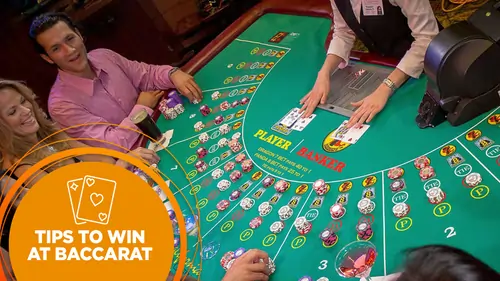
Baccarat is one of the simplest and most elegant casino games to learn. In this beginner-friendly guide, you’ll discover how the game works, what the main bets mean, and which choices give you the best odds over time.
Baccarat for beginners looks classy and intimidating, but it’s actually one of the simplest table games in any casino. You don’t need complex systems or card counting; you just need to understand the three main bets, how the hands are scored, and which choices give you the best odds over time.
This guide walks you through the rules, hand values, automatic drawing rules, and smart betting tips so you can sit down at any baccarat table—online or live—with confidence. Check the full Baccarat article.
The Basics: What Is Baccarat?
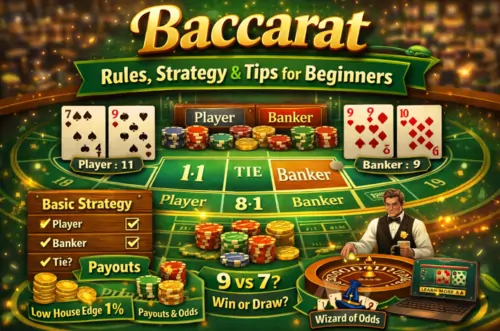
In baccarat, you don’t play against other players. Instead, you simply bet on which hand will win:
- Player hand
- Banker hand
- Tie
Each round, the dealer deals cards to the Player and the Banker according to fixed rules. Your only decision is where to place your bet before the cards are dealt.
Once bets are down, the game runs automatically: cards are dealt, third‑card rules are applied, and the winning hand is paid.
Card Values and Hand Totals
Baccarat uses a very simple scoring system:
- 2–9: worth their face value.
- 10, J, Q, K: worth 0 points.
- Ace: worth 1 point.
To calculate a hand’s total:
- Add the card values together.
- Only the last digit of the total counts (you drop the tens digit).
Examples:
- 7 + 5 = 12 → total is 2.
- 9 + 8 = 17 → total is 7.
- 4 + 3 = 7 → total is 7.
The best possible total in baccarat is 9. The hand that ends closest to 9 wins.
How a Round of baccarat for beginners Works
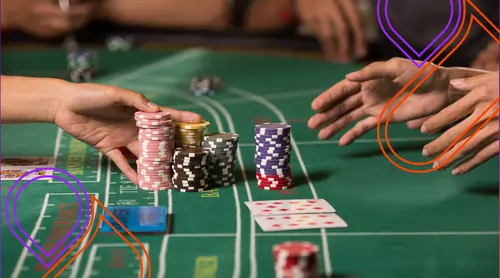
Each round follows the same simple steps:
- You place your bet on Player, Banker, or Tie.
- The dealer deals two cards to the Player hand and two cards to the Banker hand.
- Depending on the totals, a third card may be drawn for one or both hands, according to fixed rules.
- The hand with the higher total (closest to 9) wins.
- Winning bets are paid; losing bets are collected.
You never choose to hit or stand; the drawing rules are completely automatic. That’s why baccarat is so easy to learn once you understand hand values and bets.
Natural Hands: Instant Wins
If either hand gets a total of 8 or 9 with the first two cards, it’s called a natural:
- A natural 8 or 9 on Player or Banker immediately ends the round.
- No more cards are drawn.
- The higher total wins; equal totals result in a tie.
Naturals are effectively automatic “showdowns” and are one reason baccarat rounds move quickly.
When Do Hands Draw a Third Card?
You don’t need to memorize every detail of the drawing rules to play, but understanding the basics makes the game feel less mysterious.
Player third‑card rule (simplified)
- Player total 0–5: Player draws a third card.
- Player total 6–7: Player stands (no third card).
- Player total 8–9: Natural; both hands stand.
Banker third‑card rule (high‑level view)
The Banker’s decision is a bit more complex because it depends on:
- The Banker’s total.
- Whether the Player drew a third card.
- The value of the Player’s third card.
The key things beginners should know:
- The Banker usually draws with lower totals and stands with higher ones.
- Because of how these rules are written, the Banker hand has a small statistical edge over the Player hand across many rounds.
You don’t need to track these rules during play—dealers and online systems handle them automatically.
The Three Main Bets Explained (With Odds)
There are only three core bets in standard baccarat:
1. Banker Bet
You bet that the Banker hand will finish closer to 9 than the Player hand.
- Pays: usually 1:1.
- Commission: most casinos charge 5% on Banker wins (for example, bet 100, win 95 profit).
Even with this commission, the Banker bet typically has the lowest house edge, around 1.06% in standard games. Over the long run, this makes it the strongest main bet at the table.
2. Player Bet
You bet that the Player hand will finish closer to 9 than the Banker hand.
- Pays: 1:1.
- No commission taken on wins.
The Player bet has a slightly higher house edge than Banker, usually around 1.24%, but it’s still a very good bet compared to most casino games. Many players prefer it because there’s no commission to track.
3. Tie Bet
You bet that Player and Banker will end with the same total.
- Pays: commonly 8:1 or 9:1 (check your table’s rules).
The Tie bet looks tempting because of the big payout, but it has a much higher house edge—often over 14% depending on the payoff and rules. That means it’s a long‑shot bet that isn’t friendly to beginners’ bankrolls.
Short version:
- Banker: best odds, small commission.
- Player: second best, no commission.
- Tie: big payout, very weak odds.
Side Bets in Baccarat
Many baccarat tables—especially online and live dealer—offer side bets, such as:
- Player Pair / Banker Pair (first two cards form a pair).
- Big / Small (total number of cards dealt).
- Perfect Pair, Dragon, and other variants.
These can be fun for variety, but they typically come with a higher house edge than the main Banker and Player bets. As a beginner:
- Treat side bets as occasional, low‑stake extras.
- Never base your entire session around them.
Why the Banker Bet Is Usually Best
Because of the third‑card rules, the Banker hand acts last and reacts to whether the Player draws a third card. This “extra information” gives Banker a small statistical advantage.
Across a huge number of rounds under typical rules:
- Banker will win slightly more often than Player.
- The 5% commission is there to balance this edge.
Even after commission, the Banker bet’s house edge is lower than Player’s, which is why most serious baccarat strategy guides recommend Banker as the main default bet.
Best Bets for Beginners: Simple Strategy
If you want an easy, smart approach without overthinking it:
- Base your play on Banker
- Use Banker as your main bet, especially if you’re playing long sessions.
- Mix in Player if you dislike commission
- You still get low house edge and simple payouts.
- Avoid Tie as a regular bet
- It might feel exciting but is mathematically poor in the long run.
- Treat side bets as entertainment only
- Use small amounts if you want to try them; don’t rely on them.
This simple approach keeps your decisions easy and your odds as strong as possible.
For a deeper dive into baccarat rules, odds and strategy examples, you can also check this in-depth guide from Wizard of Odds.
Example Baccarat Rounds
A few examples show how everything comes together:
Example 1
- You bet on Banker.
- Player: 4 + 2 = 6 (stands).
- Banker: 3 + 3 = 6 (stands).
- Result: 6 vs 6 → Tie.
- Banker and Player bets push (no win, no loss). Only Tie bets would win.
Example 2
- You bet on Player.
- Player: 7 + 2 = 9 (natural).
- Banker: K + 8 = 8 (natural).
- No more cards are drawn.
- Player wins 9 vs 8. Player bets are paid 1:1, Banker bets lose, Tie bets lose.
Example 3
- You bet on Banker.
- Player: 2 + 3 = 5 (Player draws a third card).
- Player draws a 7 → total becomes 2 (2 + 3 + 7 = 12 → 2).
- Banker: 4 + 2 = 6 (according to the rules, Banker stands).
- Result: Banker 6 vs Player 2. Banker bets win (minus commission if applied).
These examples show how you don’t make hit/stand choices; you simply pick which hand you think will come out on top.
Common Beginner Mistakes to Avoid
Avoiding a few classic mistakes will instantly make you a smarter baccarat player:
- Chasing the Tie bet
- The high payout is attractive, but the true odds are poor. Use Tie rarely, if at all.
- Overusing side bets
- Side bets usually have higher house edges; they should be occasional fun, not your main plan.
- Chasing losses by increasing stakes
- Raising bets after losses doesn’t change the odds and can drain your bankroll quickly. Stick to a consistent bet size that suits your budget.
- Believing in “streak systems”
- Seeing several Banker or Player wins in a row doesn’t change the odds of the next hand. Baccarat outcomes are independent, so avoid betting systems that promise guaranteed wins.
Bankroll Tips and Table Etiquette
Baccarat is simple, but it’s still gambling, so treat it with respect:
- Set a fixed budget before you start and never exceed it.
- Decide on a win target and loss limit so you know when to walk away.
- Take regular breaks, especially during online or live‑dealer sessions.
- At live tables, wait for the current round to finish before joining, and follow the dealer’s instructions for placing and removing chips.
Online baccarat often offers lower minimum bets than traditional high‑limit rooms, making it an ideal environment for beginners to practice.
Quick Start Checklist for Beginners
Before placing your first real‑money bet, ask yourself:
- Do I understand that my only decision is which bet to place (Banker, Player, or Tie)?
- Do I know that Banker has the best odds, followed closely by Player?
- Am I prepared to avoid Tie and keep side bets small and occasional?
- Have I set a clear budget and time limit for my session?
If the answer is yes, you’re ready to enjoy baccarat as a simple, elegant game where smart bet selection and good bankroll discipline make all the difference.
If you ever feel that your gambling is no longer fun or under control, visit the Responsible Gambling Council for independent information and support.
