
Blackjack is one of the most popular and widely recognized casino table games, both in land‑based casinos and online. It attracts millions of players thanks to its simple rules, fast gameplay, and a rare mix of luck and strategy.
Unlike many casino games that rely purely on chance, blackjack allows players to make decisions that influence the outcome of each hand. The objective is simple:
- Beat the dealer by getting a hand value closer to 21 than the dealer, without going over.
- If your hand exceeds 21, it’s called a bust, and you automatically lose the round.
Because it balances luck with skill, blackjack remains a favorite for both beginners and experienced players.
How to Play Blackjack (Step by Step)
Understanding the basic flow of the game makes learning blackjack much easier.
- Place Your Bet
Before any cards are dealt, each player places a wager in the betting area. - Cards Are Dealt
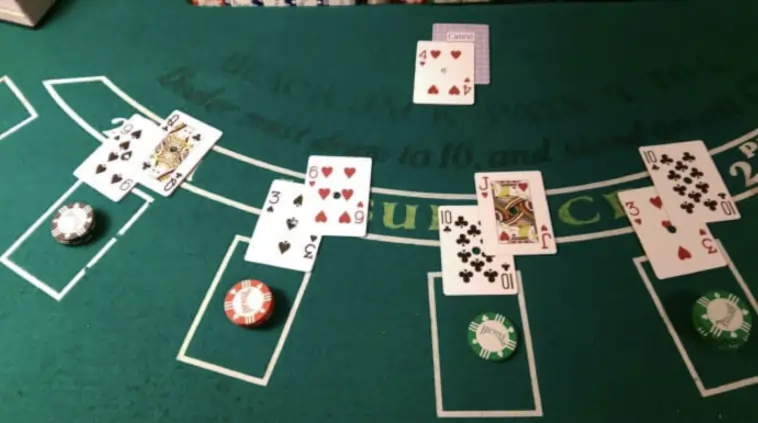
Each player receives two cards, usually face up. The dealer also receives two cards: typically one face up (the “upcard”) and one face down (the “hole card”). - Evaluate Your Hand
You look at your total and compare it with the dealer’s upcard to decide how to play your hand. - Choose Your Action
On your turn, you can usually:- Hit
- Stand
- Double down
- Split (when allowed)
- Dealer Plays
After all players finish, the dealer reveals the hole card and must play according to fixed rules. In most games, the dealer must hit until at least 17 and stand on 17 or higher (with some tables specifying whether the dealer hits or stands on a “soft 17”). - Determine the Winner
- If your hand is closer to 21 than the dealer’s without busting, you win.
- If the dealer busts and you don’t, you also win.
- If both you and the dealer have the same total, the result is a push (tie), and your bet is returned.
Blackjack Card Values and Basic Hands
Blackjack uses one or more standard 52‑card decks. Card values are:
- Number cards (2–10): Worth their face value.
- Face cards (Jack, Queen, King): Each worth 10 points.
- Ace: Can count as 1 or 11, whichever is more beneficial to your hand.
Example hands:
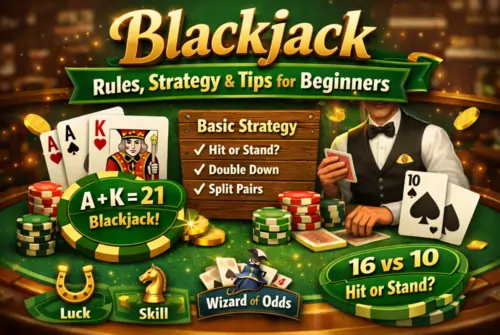
- Ace + King = 21 (this is a natural blackjack)
- Ace + 7 = 8 or 18 (called a “soft 18” because the Ace can still count as 1 or 11)
- 10 + 9 = 19 (a “hard 19” because there is no Ace counted as 11)
A natural blackjack (an Ace plus any 10‑value card as the first two cards) typically pays 3:2. For example, a 10 credit bet returns 15 credits on a blackjack win. Some tables offer 6:5 or even lower payouts, which are much less favorable for players, so it’s wise to avoid these whenever possible.
Common Blackjack Actions
During each round, you choose how to play your hand. The main actions are:
Hit
You request another card to increase your hand total.
- Used when your total is low or when you’re likely behind the dealer.
- If you bust (go over 21), your hand loses immediately.
Stand
You keep your current cards and end your turn.
- Used when your total is strong enough or when the dealer is likely to bust.
- Standing means you are satisfied with your current total.
Double Down
You double your original bet and receive exactly one more card, then you must stand.
- Commonly used when you start with a strong total like 9, 10, or 11 and the dealer shows a weaker card.
- Doubling down can increase profits in favorable situations, but also increases risk, so it should follow basic strategy.
Split
If your first two cards have the same value (for example, 8–8 or Q–Q), you may split them into two separate hands by placing an additional bet equal to your original wager.
- Each new hand then receives an additional card and is played independently against the dealer.
- Some pairs are strong candidates for splitting (like A–A and 8–8), while others are usually better kept together (like 10–10).
Why Blackjack Is So Popular
Blackjack has remained a casino classic for decades because it offers several player advantages:
- Low House Edge
When played with basic strategy at favorable rules tables (for example, 3:2 blackjack payouts and standard dealer rules), the house edge can drop to around 0.5–1%. Rule changes like 6:5 payouts or restrictions on doubling increase this edge significantly. - Strategy Matters
Unlike pure luck games, blackjack rewards informed decisions. Players can use strategy charts based on probability to choose the mathematically best move for each situation. - Fast and Engaging Gameplay
Rounds move quickly, and players are actively involved in decisions, making the game both exciting and mentally engaging.
Basic Blackjack Strategy for Beginners
Basic strategy is a mathematically derived guide that tells you the optimal move (hit, stand, double, or split) for every possible combination of your hand and the dealer’s upcard. These charts are built from probability calculations and millions of simulated hands.
Basic strategy usually considers:
- Your total (hard or soft)
- Whether your hand includes an Ace counted as 11 (soft)
- The dealer’s visible upcard
- The number of decks and table rules
By following basic strategy, you can significantly reduce mistakes and bring the house edge down to its minimum for that game.
Simple Starter Rules (Easy to Remember)
For a beginner, you don’t need to memorize the full chart right away. Start with a few core guidelines:
- Always hit totals of 11 or less.
- Stand on hard 17 or higher.
- Always split Aces and 8s.
- Never split 10s or 5s.
- Double down on 10 or 11 when the dealer shows a lower card, if the rules allow.
- With a soft hand (Ace counted as 11), be more willing to hit or double down, because you’re less likely to bust.
For deeper strategy charts and calculators, many players use independent analysis sites such as Wizard of Odds and similar resources, which show exact moves for specific rule sets.
For players who want a full, visual strategy chart, you can check independent tools like the Wizard of Odds Blackjack Basic Strategy Calculator.
Example of a Basic Strategy Decision
Here’s a simple example of how basic strategy can differ from “gut feeling”:
- You are dealt a hard 16 (for example, 10 + 6).
- The dealer’s upcard is 10.
Many beginners dislike hitting here because they fear busting. However, in most standard games:
- Basic strategy recommends surrendering if that option is available, because the hand is mathematically very weak.
- If surrender is not available, basic strategy usually recommends hitting, even though it feels risky, because standing against a strong dealer 10 loses more over the long term.
This type of counter‑intuitive decision shows why learning basic strategy can improve your long‑term results.
Common Beginner Mistakes in Blackjack
New players often fall into habits that quietly increase the house edge. Some of the most common mistakes include:
- Playing Without Any Strategy
Making random decisions or relying purely on “hunches” instead of following at least a simple basic strategy guideline. - Taking Insurance Too Often
Insurance is a side bet offered when the dealer shows an Ace, paying if the dealer has blackjack. In most cases, this bet has a higher house edge and is not favorable for the player over time. - Overusing Side Bets
Many blackjack tables offer side bets (like Perfect Pairs or 21+3). While fun, they usually carry a much higher house edge than the main game. - Chasing Losses
Increasing bet sizes aggressively after losses to “win it back” can quickly lead to overspending. Blackjack should be treated as entertainment, not a guaranteed way to make money. - Ignoring Bankroll Management
Not setting clear limits or betting too large a portion of your bankroll on a single hand can turn a fun session into a short one.
Blackjack: Luck vs Skill
Blackjack stands out among casino games because it blends chance with skill:
- Luck
- You cannot control the order of the cards.
- Short‑term results will always vary; you can play perfectly and still lose a session.
- Skill
- You control when to hit, stand, double, or split.
- Using basic strategy and solid bankroll management improves your long‑term results, even though it can’t guarantee wins.
This combination makes blackjack one of the most intellectually engaging casino games, appealing to players who enjoy both action and decision‑making.
Final Thoughts
Blackjack is one of the most exciting and accessible casino table games available today. Its easy‑to‑learn rules, quick rounds, and strategic depth make it ideal for both new players and experienced gamblers.
By understanding card values, learning core strategy principles, and making informed decisions each round, you can keep the house edge as low as possible while enjoying the game. Always choose tables with player‑friendly rules (especially 3:2 blackjack payouts) and avoid high‑house‑edge bets such as poor insurance or side bets when you’re starting out.
If you’re new to the game, keep an eye out for our upcoming Blackjack Strategy for Beginners Guide, where we’ll break down key hands, decision‑making patterns, and practical tips so you can sit at the table with more confidence.
If you’re new to the game and want to move beyond the basics, check out our in‑depth Blackjack Strategy for Beginners Guide on 18ClubSG Blog.
